Showing posts with label reading. Show all posts

Thursday, June 2, 2011

Current reading: Franz Kafka


Logic is doubtless unshakable, but it cannot withstand a man who wants to go on living.


           - Franz Kafka, The Trial
                   (comic by R. Crumb)

Thursday, May 12, 2011

Current reading: Italo Calvino


The inferno of the living is not something that will be; if there is one, it is what is already here, the inferno where we live everyday, that we form by being together. There are two ways to escape suffering it.

The first is easy for many: accept the inferno and become such a part of it that you can no longer see it. The second is risky and demands constant vigilance and apprehension: seek and learn to recognize who and what, in the midst of the inferno, are not inferno, then make them endure, give them space.

                 - Italo Calvino, Invisible Cities

Saturday, April 23, 2011

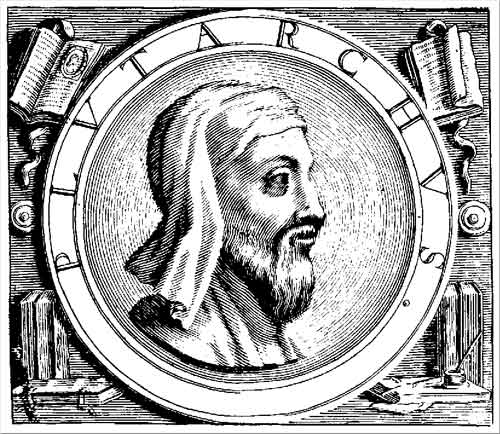
Current reading: Plutarch


When we have a fever, everything tastes bitter and unpleasant, but once we have seen other people taking the same food without revulsion, we stop blaming the food and drink, and start to blame ourselves and our illness. In the same way, we will stop blaming and being disgruntled at circumstances if we see other people cheerfully accepting identical situations without getting upset. So when unwelcome incidents occur, it is also good for contentment not to ignore all the gratifying and nice things we have, but to use a process of blending to make the better aspects of our lives obscure the glare of the worse ones. But what happens at the moment is that, although when our eyes are harmed by excessively brilliant things we look away and soothe them with the colours that flowers and grasses provide, we treat the mind differently: we strain it to glimpse the aspects that hurt it, and we force it to occupy itself with thoughts of the things that irritate it, by tearing it almost violently away from the better aspects. And yet the question addressed to the busybody can be transferred to this context and fit in nicely: 'You spiteful man, why are you so quick to spot someone else's weakness, but overlook your own?' So we might ask: why, my friend, do you obsessively contemplate your own weakness and contantly clarify and revivify it, but fail to apply your mind to the good things you have?

                           - Plutarch, "On Contentment"


Thursday, March 3, 2011

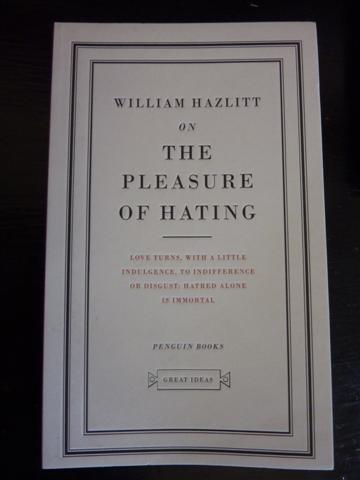
Current reading: William Hazlitt

I hate people who have no notion of any thing but generalities, and forms, and creeds, and naked propositions, even worse than I dislike those who cannot for the soul of them arrive at the comprehension of an abstract idea. There are those (even among philosophers) who, deeming that all truth is contained within certain outlines and common topics, if you proceed to add colour or relief from individuality, protest against the use of rhetoric as an illogical thing; and if you drop a hint of pleasure or pain as ever entering into 'this breathing world', raise a prodigious outcry against all appeals to the passions.
It is, I confess, strange to me that men who pretend to more than usual accuracy in distinguishing and analysing, should insist that in treating human nature, of moral good and evil, the nominal differences are alone of any value, or that in describing the feelings and motives of men, any thing that conveys the smallest idea of what those feelings are in any given circumstances, or can by parity of reason ever be in any others, is a deliberate attempt at artifice and delusion - as if a knowledge or representation of things as they really exist (rules and definitions apart) was a proportionable departure from the truth. They stick to the table of contents, and never open the volume of the mind. They are for having maps, not pictures of the world we live in: as much as to say that a bird's-eye view of things contains the truth, the whole truth, and nothing but the truth. If you want to look for the situation of a particular spot, they turn to a pasteboard globe, on which they fix their wandering gaze; and because you cannot find the object of your search in their bald 'abridgements', tell you there is no such place, or that it is not worth inquiring after. They had better confine their studies to the celestial sphere and the signs of the zodiac; for there they will meet with no petty details to boggle at, or contradict their vague conclusions. Such persons would make excellent theologians, but are very indifferent philosophers.

- William Hazlitt, "On Reason and Imagination" (1826)

Tuesday, February 15, 2011

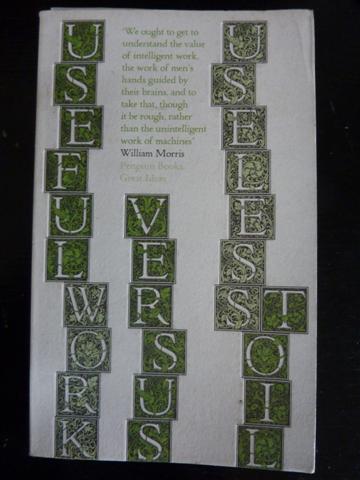
Current reading: Useful Work Versus Uesless Toil

What is the nature of the hope which, when it is present in work, makes it worth doing?

It is threefold, I think - hope of rest, hope of product, hope of pleasure in the work itself; and hope of these also in some abundance and of good quality; rest enough and good enough to be worth having; product worth having by one who is neither a fool nor an ascetic; pleasure enough for all for us to be conscious of it while we are at work; not a mere habit, the loss of which we shall feel as a fidgety man feels the loss of the bit of string he fidgets with.

                                  -- William Morris, Useful Work vs. Useless Toil

Monday, February 7, 2011

Current reading: Old Man and the Sea


Luck is a thing that comes in many forms and who can recognize her?

-- Ernest Hemingway, The Old Man and the Sea


Thursday, January 20, 2011

Current reading: Hell's Angels

Nearly everyone who has ridden a bike for any length of time will agree. The highways are crowded with people who drive as if their sole purpose in getting behind the wheel is to avenge every wrong ever done them by man, beast or fate. The only thing that keeps them in line is their own fear of death, jail and lawsuits ... which are much less likely if they can find a motorcycle to challenge instead of another two-thousand-pound-car or a concrete abutment. A motorcyclist has to drive as if everybody else on the road is out to kill him. A few of them are, and many of those who aren't are just as dangerous - because the only thing that can alter their careless, ingrained driving habits is a threat of punishment, either legal or physical, and there is nothing about a motorcycle to threaten any man in a car.  
-- Hunter Thompson, Hell's Angels
 And that was written in 1966, way before texting and driving ...